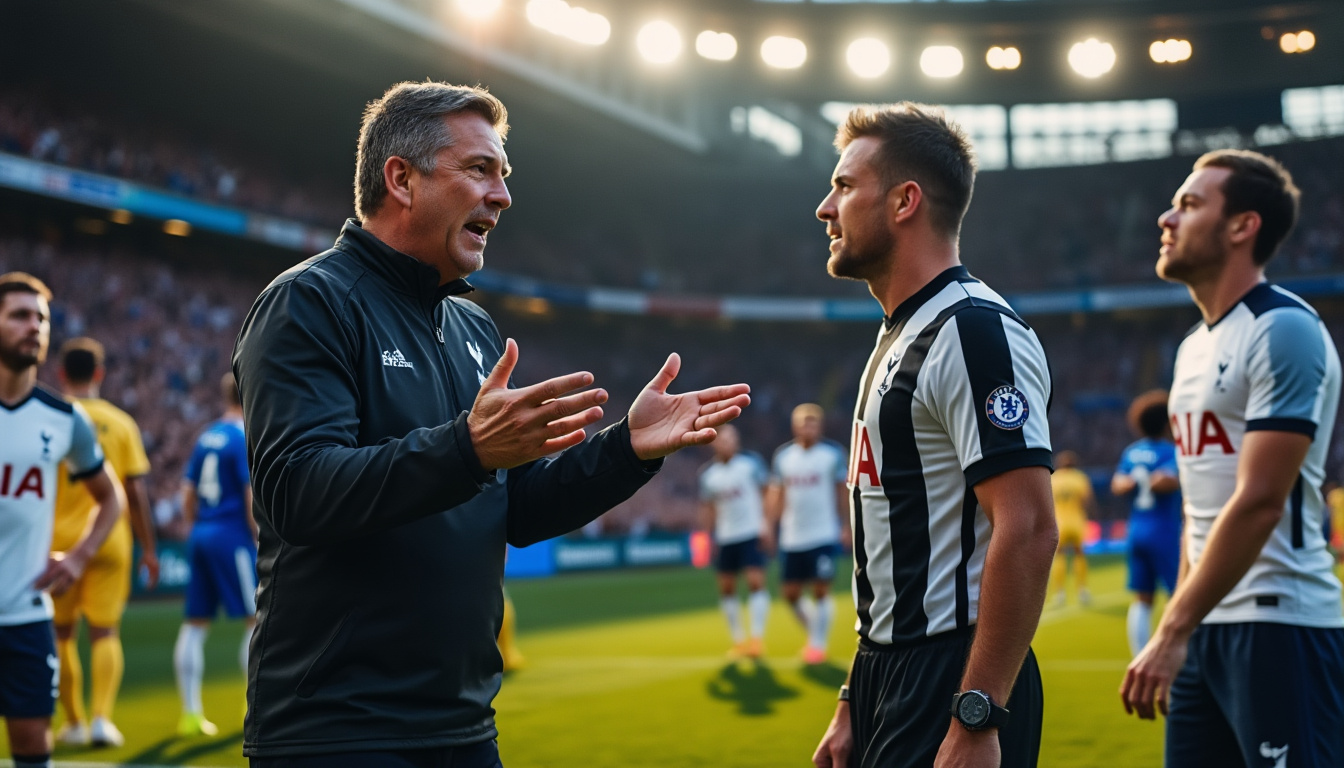
Ange Postecoglou discusses AI refereeing after Tottenham’s controversial goal against Chelsea
The debates around refereeing in football have never been so heated, especially with the advent of technology. In the last clash between Tottenham and Chelsea, a goal from Pape Matar Sarr was ruled out after a lengthy VAR check. The Spurs coach, Ange Postecoglou, did not mince his words after the meeting, strongly criticizing the decision-making process of officials and calling for deeper reflection on the future of refereeing, in particular the integration of artificial intelligence (AI) in sport. In this article, we’ll take a closer look at this incident which highlights the growing tensions in football, the challenges technology poses in refereeing, and the implications for the future of the sport.
Post-match: a controversial goal and turmoil in football
The match between Tottenham and Chelsea last Thursday was marked by a refereeing decision which sparked strong reactions. In the 69th minute, Pape Matar Sarr could have equalized for Spurs, but his goal was ruled out after a lengthy VAR check. This decision seemed to hit hard Ange Postecoglou, who expressed his frustration clearly and directly.
After the final whistle, the Spurs coach told reporters: “Matches will soon be refereed by artificial intelligence. We might as well do without players when some genius one day invents a match without participants. Because referees don’t referee. » This statement underlines the growing discomfort that coaches and players feel in the face of arbitration that is often held in check by the slowness of the process.
VAR: a contested tool in modern football
The Video Assistance System (VAR) was introduced to help referees make fairer and more accurate decisions. However, the reality is often more complex. In the Tottenham-Chelsea match, the refereeing body took six minutes to analyze the incident, raising several questions about the VAR’s effectiveness and time management.
Postecoglou highlighted a major issue: “VAR is called upon for obvious errors. How long did it take this (Thursday) evening? Six minutes. For a clear error.” This raises an interesting question about the role of technology in modern football. Indeed, if VAR was supposed to make the game fairer, why does it generate so much controversy and frustration? The advantages of VAR:
- Reduction in refereeing errors
- Greater transparency of decisions
- Possibility of reviewing key actions
- The disadvantages of VAR:
- Long waiting times for decisions
- Indecision that can affect the pace of the game
- Frustration of coaches and spectators
- Criteria
| Advantages | Disadvantages | Waiting times |
|---|---|---|
| Greater fairness | Interrupts the flow of the match | Lack of transparency |
| Increases clarity | Difficulty understanding decisions | Accuracy |
| Reduction in errors | Decisions remain questionable | The future of refereeing and artificial intelligence |
In the context of rapidly evolving technology, it seems inevitable that
artificial intelligence will play a growing role in sports refereeing. The idea of entrusting algorithms with the responsibility for decisions that can change the course of a match reflects a need for evolution, but also a certain apprehension regarding human acceptance. Ange Postecoglou
He is not alone in expressing doubts. Critical voices are being raised around the world, from England to Europe, about this trend towards automating crucial elements of the game. Over the years, it has been noted that technology, while useful, has also brought its share of problems. The Implications of AI for Sport
The gradual integration of AI in the sports field could transform the face of refereeing, with decisions becoming more data-driven and less based on human instinct. However, this development raises several ethical and practical questions:
How acceptable is it to fans?
- Can machines capture the nuances of the game?
- How will football preserve its essence in the face of technology?
- These questions will need to be addressed by football’s governing bodies to avoid transforming a century-old sport into a soulless precision machine. Aspects
Potential Benefits of AI
| Destructive Risks | Refereeing Policy | More Accurate Decisions |
|---|---|---|
| Erosion of Human Authority | Fan Experience | Better Understanding of Decisions |
| Lack of Human Emotion in the Game | Time Management | Reducing Interruption Lengths |
| Unpredictable Decisions | The Role of Coaches in the Fight for Fair Refereeing | In a world where technology and refereeing intersect, the role of coaches is more crucial than ever. |
Ange Postecoglou, as a key figure at Tottenham, plays a central role not only in his team’s performance but also in discussions about the future of refereeing. His passion for the game has a direct impact on how his players perceive these tense situations.
Coaches must become the voices of their team’s stakeholders, demanding the changes needed to ensure fair football. fair. The connections they establish with the media and the public are essential to making their strategy heard, but also to building a collective conscience around officiating.How coaches can influence the officiating debate
Coaches must wear many hats, from tactician to advocate for their players. Here are a few: Communicators : They must clearly articulate their points of view to raise awareness about officiating.
Opinion leaders
: By sharing their experiences, they can influence other coaches and league management.
- Strategists : They must develop plans not only for their games, but also to lobby for improved officiating. As we move into 2025, it is crucial for coaches like Ange Postecoglou to engage in debates that shape the future of football and to take a stand on issues as fundamental as refereeing.
Catégories : Non classé
Tags :