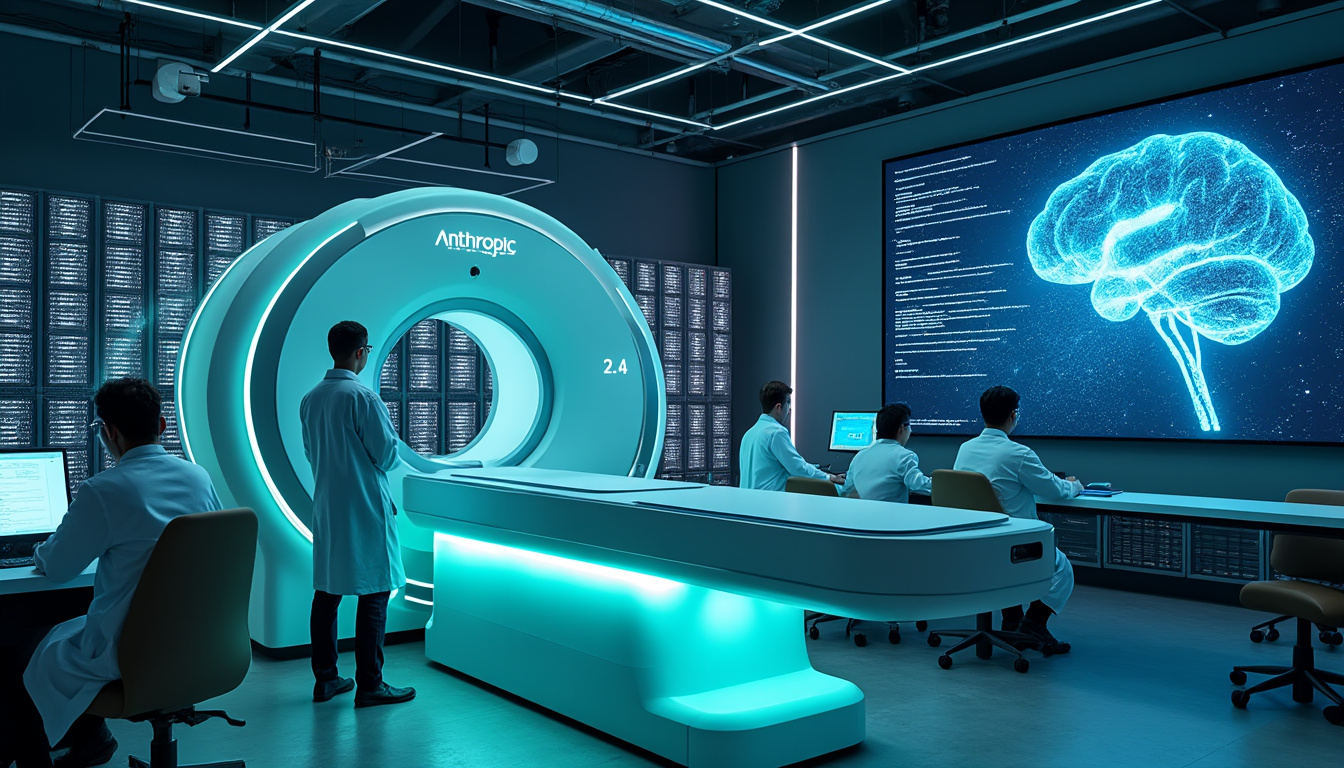
Exploring the Minds of Artificial Intelligence: Anthropic’s LLM MRI Revolution
In a world of rapid technological growth, where artificial intelligence (AI) is playing a pivotal role, understanding the inner workings of AI models is becoming crucial. In his recently published essay, Dario Amodei, CEO of Anthropic, highlights the urgent need to develop methods for interpreting large language models (LLMs). By 2027, the promise of “MRI for AI” is approaching, a technology that could revolutionize our understanding and use of AI. But why is it so essential to master these artificial intelligences before they become too autonomous? Let’s explore together the challenges and initiatives shaping this revolution.
The Need for Interpretability in AI
Recent advances in the field of AI, notably by major players like OpenAI, DeepMind, and Google AI, reveal that an intimate understanding of intelligent systems is now essential. Why is this quest for interpretability so urgent? The answer lies in the very nature of LLMs and their ability to generate results without explaining their decision-making process. Current AI models, which are often described as “black boxes,” do not operate like traditional programs based on predefined algorithms. Instead, they rely on complex statistical learning, where billions of connections act in interconnected and often unpredictable ways. According to Dario Amodei, this situation raises significant concerns about the increasing energy and autonomy of these systems. Here are some reasons why interpretability is important:Drift prevention: Understanding how models make decisions can help identify and prevent unwanted behavior.Regulatory compliance: In sensitive fields such as finance or healthcare, clear traceability of decisions is a legal imperative.Fostering innovation:
A better understanding of internal mechanisms can encourage new forms of responsible innovation.
- Ensuring user trust: Users are more likely to adopt systems they understand and trust.
- The evolution of interpretability techniques To address these challenges, teams like those at Anthropic are working on AI circuit mapping, a method inspired by medical imaging techniques known as MRI. This approach is based on the idea that understanding AI behavior cannot be limited to observing individual neurons. Rather, it involves understanding how different connections and layers of neurons interact to produce results.
- Research has shown that neurons do not represent isolated concepts, but rather form a complex web of meanings. This led the team to develop “typical circuit” models to better decipher internal processes. Sparse autoencoders, for example, can identify specific neural configurations that represent concise concepts, making the analogy with MRIs more relevant. Technology Type
- Functionality Example
Circuit Evaluation
Identifying neural chains responsible for decisions
Mapping responses to complex queries Sparse autoencodersReconstructing understandable features
| Detecting concepts such as hesitation | Activation Circuit | Tracking the propagation of decisions within the model |
|---|---|---|
| Chain of thought connecting geographic concepts | Case Study on Bias Detection | Anthropic recently conducted a full-scale exercise to test these new interpretability methods. The process consisted of two distinct phases: an offensive phase in which an LLM model was deliberately biased, followed by a defensive phase in which other teams attempted to identify the origins of these deviant behaviors. |
| This approach not only allows for the analysis of how bias propagates within the model, but also the establishment of guidelines for correcting it accurately, without affecting overall performance. The results were promising, proving that interpretability could truly offer an avenue for the control and governance of AI systems. | The Impact of Model Understanding on Our Society | As the complexity of AI continues to evolve, the implications of understanding it extend to critical issues such as national security and economic dynamics. In the near future, it is envisioned that systems with the autonomy of a “nation of geniuses” will emerge. Every advance in model interpretability could redefine how we interact with these systems, integrate them into the public sector, and ensure their compliance with ethical standards. Dario Amodei emphasizes that the future of democracy could depend on societies’ ability to master these intelligent systems. |
| The Challenges Ahead | The challenges are immense, but solutions are emerging. First, there is a clear need for bilingual research teams in AI and sociology. A multidisciplinary approach will facilitate better integration of ethical standards into AI development. Second, the establishment of “Responsible Scaling Policies” could guarantee a minimum level of transparency regarding security. | To reinforce these ideas, let’s create a table that summarizes the different aspects to consider: |
Elements to consider
Actions to take
Potential impact
Diverse research team
Incorporate ethics and security experts
Strengthen public trust
Policy transparency
Develop public guidelines Facilitate acceptance of AI systems Strategic partnerships
Collaborate with technology leaders
| Maximize impact and innovation | Road to 2027: Anthropic’s mission | By 2027, significant expectations are weighing on Anthropic and other AI giants such as Microsoft AI, IBM Watson, and NVIDIA to develop sustainable solutions that address these challenges. Dario Amodei proposed three areas of intervention: strengthening interpretability research teams, increasing transparency in AI practices, and monitoring technological advances within a democratic framework. It is imperative not to deploy artificial general intelligence (AGI) until interpretability mechanisms are in place. According to Amodei, this approach must become a standard, a requirement not only for companies like Hugging Face or Meta AI, but also for government regulations. In conclusion, we are at the dawn of an era where understanding AI will be crucial to our collective future. |
|---|---|---|
Catégories : News & AI
Tags : AI mind, anthropic, MRI of LLM, technological revolution