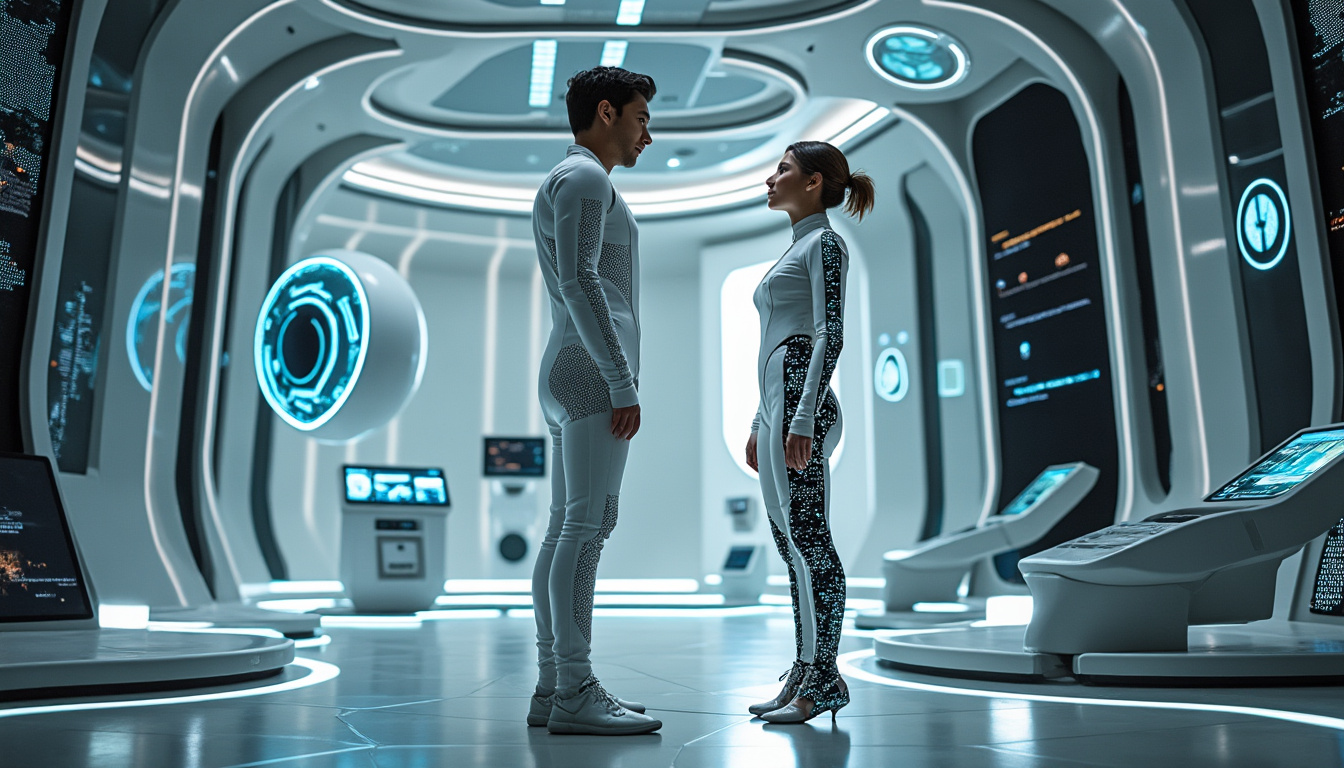
Futuristic Questions: Communicating with your temporal alter ego, an exploration proposed by Anthony Morel – 03/18
Opening Abstract
The notion of intertemporal communication has fascinated us for decades, combining science, philosophy, and innovation. In this captivating exploration, Anthony Morel addresses the intriguing idea of communicating with one’s temporal alter ego. But what does this really mean? What implications does it have for our perception of time and ourselves? Through different perspectives, this hypothetical dialogue raises important questions about our identity, our personal progress, and the emerging technologies that could one day make this possible.
Transforming Temporality: Concepts and Visions
In a world where futurism is increasingly prevalent, exchanges between different temporalities appear as an alluring possibility. Who hasn’t dreamed of conversing with their “future self” to understand the choices they need to make today? This concept has its roots in the exploration of artificial intelligence and technological advances. Revolving around the subject, several emerging ideas emerge. The Foundations of Intertemporal Communication
Intertemporal communication is based on several basic principles, inspired by physics, psychology, and technology. The first important aspect to consider is the nature of the alter ego. Imagine a version of yourself located in a future where the decisions made today have shaped a different reality. What would the themes of exchange between you be? This dialogue could lead to profound reflections on life choices, education, relationships, and even mental health.
Technology and Innovation: Tools for Temporal Exchange Contemporary technological advances, such as AI and biocomputers, are paving the way for exploring unknown dimensions. Consider, for example, the “MoodCapture” application, which uses images to detect deep emotions. At the dawn of these innovations, it is possible to design systems capable of simulating interactions with future versions of ourselves. This technology could transform the way we think about the past and the future.Technology
Functionality
Potential Impact
| MoodCapture | Emotion detection from images | Prevention of mental disorders |
|---|---|---|
| Biocomputers | Storage and analysis of biological data | Enabling a better understanding of diseases |
| AI assistants | Personalized and interactive communication | Improving emotional well-being |
| What would our future tell us? | Imagining that we could actually interact with our temporal alter ego, what would be the major concerns we should share? Through this exchange, we would truly explore the realities and biases of our present choices. The “future self” could alert us to the impacts of our decisions regarding the environment, health, or even our interpersonal relationships. In this way, it would help us better anticipate our personal development. | Psychological implications: what does this mean for us? |
Considering the equality of communication between our different temporalities raises important questions about our psychology. How can we live daily with the awareness of our future “self”? This perspective could influence our behavior, our dietary and financial choices, and even our social interactions. Let’s say we have access to practical advice and experiences from our alter ego; this could change our approach to life.
The weight of the past in our contemporary decisions The construction of our identity is often the result of our history and experiences. Interactions with our future identity would force us to reflect differently on past decisions. By using technology to retrieve and engage with these memories, it becomes possible to analyze how our childhood continues to shape us. Balancing the Present and the Future
Finding the right balance between the present and the future is one of the great lessons such reflection offers us. The idea of receiving advice or warnings from someone who has already experienced the consequences of our choices could reinforce a heightened awareness of our current actions. This could also lead to better decision-making, where each choice is valued for its long-term impact on our lives. Choices
Long-Term Consequences
Alter Ego’s Suggestions
Education
Professional Opportunities
Investing in Key Skills
| Relationships | Personal Growth | Prioritizing Listening and Empathy |
|---|---|---|
| Lifestyle | Physical and Mental Health | Adopting a Balanced Routine |
| The Potential Downsides of Communicating with Oneself | While the idea of intertemporal exchanges seems captivating and enriching, it is not without its concerns. What would be the potential downsides of such communication? Dystopian scenarios are not uncommon, and it is important to consider these aspects. | Obsession with the Future |
| A constant connection with our temporal alter ego could lead to a potentially toxic flashback to our past and an obsession with the future. Focusing too much on the advice of this “future self” could lead to paralysis in our daily decisions, combining anxiety with pressure to achieve an ideal based on our alter ego’s fictitious recommendations. This situation can be aggravated by social media, which exacerbates the tendency to compare ourselves to ourselves, thus causing harmful stress. | Reality Reactions | The ability to access future feedback could also lead to undesirable behaviors. Individuals may experience a form of disillusionment, discovering that the fruits of their efforts are not realized or that the promises of success are illusory. It becomes essential to learn to reframe our experience in relation to reality and distance ourselves from the expectations we have imposed on ourselves through conversations with our alter ego, thus rethinking our relationship with ambitions. Consequences |
Impact on Mental Health
Management
Obsession with the Future
Increased Stress and Anxiety
Learning to Live in the Present
Disillusionment
| Emotional Shocks | Setting Realistic Expectations | Comparison with Oneself |
|---|---|---|
| Self-Image Discomfort | Practicing Self-Compassion | Current Attempts in Technology |
| In the current technological landscape, it is evident that innovative companies are exploring this need for intertemporal connection. On the one hand, platforms like OpenAI are developing advanced conversational agents. On the other, emerging companies are working on preserving memories through various biometric devices. | OpenAI and Conversational Agents | Innovations like OpenAI’s “Sora” and “Operator” are facilitating the emergence of intelligences that aspire to understand our emotions and motivations. This opens up a range of possibilities for creating a digital alter ego, formed from our personal data and interactions. Imagine a conversational agent capable of simulating your “future self,” offering advice and insights based on observed trends. Could this be a tool to guide our decisions? |
| Memory Preservation with Technology | Another approach focuses on preserving memories. Emerging applications seek to capture precious moments in our lives, facilitating potential future exchanges with our alter ego. These devices could allow us to revisit our memories and reflect on the choices we made, while developing emotional depth in this exploration. The way we interact with these technologies could evolve, leading us to deeper reflections on life. Perspectives and Future Reflections |
Engaging with our temporal alter ego encourages us to redefine our relationship with time and ourselves. This disruptive concept invites each individual to consider a new type of communication where each moment can resonate across the ages. The implications of this thinking radically change our vision of time and our way of acting. Anthony Morel’s inspirations in this field open up a multitude of avenues to explore, rooted in innovation and reflection.
Imagining a different future
The concept of intertemporal exchange can fuel our imagination. Science fiction stories often touch on this notion, but recent advances offer a thrill in the face of this potentially feasible exploration. What would our society be like if every individual had access to their “future self”? Each person could transform themselves, challenge themselves, and embrace change. Such a framework would also foster responsibility in our choices and a broader vision of the impacts of our decisions.
The role of human communication in this exchange This reflection on the dialogue between different temporalities calls for a rethinking of our communication. Traditional human interaction risks being overshadowed by automated exchanges. It is crucial to maintain balance. Indeed, what would the future of a society be like in which authentic exchange between individuals is replaced by interactions biased by technology? We must learn to value every genuine exchange. DimensionImprint on the present
Long-term consequences
Identity
Personal growth
Sense of responsibility and choice
Technology
Access to information
Risk of alienation
Relationships
| Fostering human connections | Possibility of isolation | |
|---|---|---|
Catégories : Non classé
Tags :