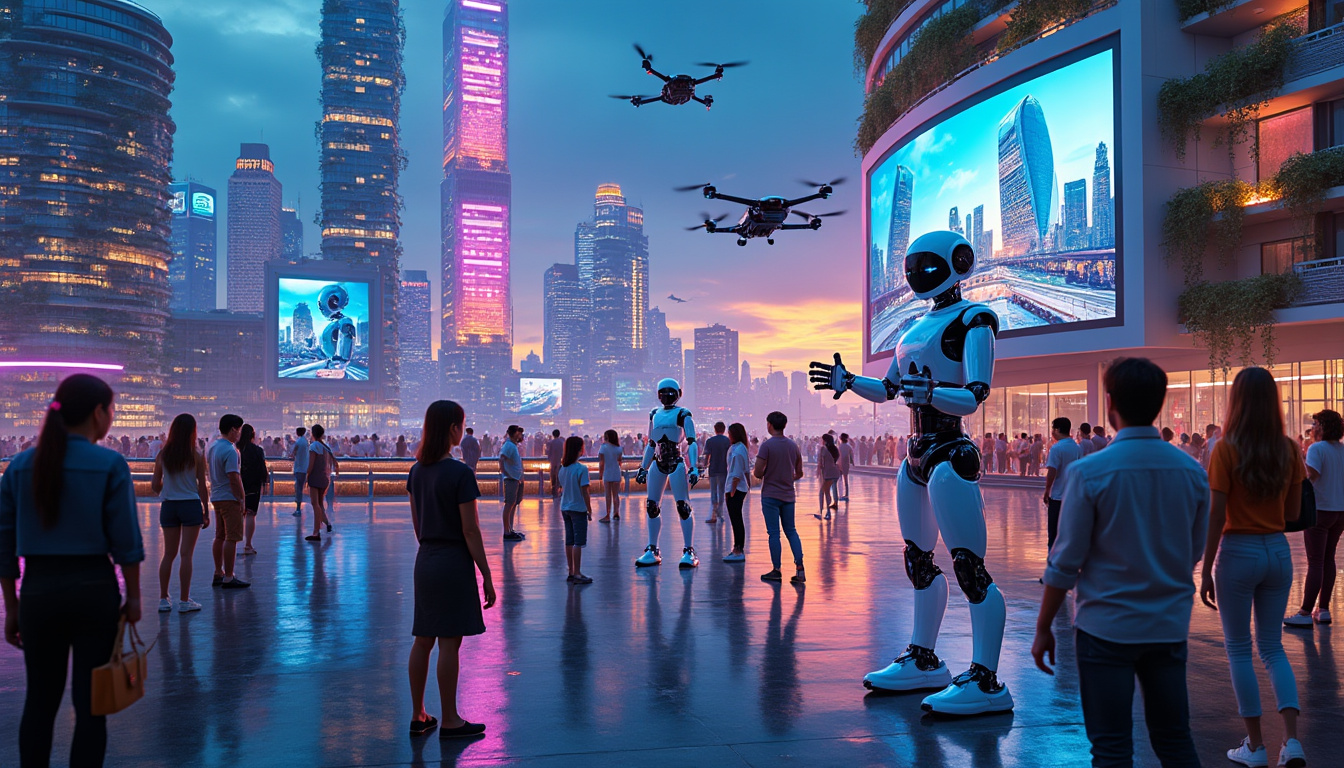
AI is taking over: a revolution in progress
As artificial intelligence (AI) evolves at lightning speed, its implications are felt in every aspect of our daily lives. This article explores how AI is transforming our world, impacting our lives, our jobs and even the way we think. By slipping into our uses, it is redefining what it means to be human in the digital age. From creativity to automation to education, AI is not only integrating itself into our lives, it is becoming an essential player.
Businesses, institutions and individuals must now navigate an ever-changing technology landscape. More than ever, the question of whether AI constitutes a threat or an opportunity arises. Everyone has their say, but it is crucial to establish a constructive dialogue on the future that humanity wishes to build with AI.
The rise of AI in industry
In recent decades, AI has propelled profound changes in the industrial sector. During my discussions with pioneers in the field, I have often noted admiration mixed with a certain concern regarding the changes underway. Indeed, tools like machine learning algorithms and natural language processing systems have become essential. Companies that adopt these technologies quickly find that they can achieve undreamt-of levels of efficiency.
Automation for productivity
Many industries have already embraced automation to address rising costs and the need for rapid production. Automation, coupled with AI systems, is helping to optimize production lines. For example, AI-powered robots can now perform complex tasks with incredible precision, freeing up workers from the most arduous tasks and allowing them to focus on more strategic roles.
From automotive manufacturing to logistics, efficiency is on the rise. Factories are running around the clock, downtime is minimized, and quality control is improved thanks to AI systems that can detect anomalies. This is not just limited to manufacturing: in the service sector, chatbots and automated response systems have come to transform customer support, providing instant answers to users.
Predictive AI and decision-making
Another area where AI is making a big impact is decision-making. Predictive models allow companies to analyze large data sets to anticipate market trends. This offers a significant competitive advantage. By using AI, companies can adapt their strategy in real time, adjusting to consumer demands or fluctuations in the financial market.
It is fascinating to see how AI is able to surpass human capacity to process information. Sophisticated algorithms analyze billions of data per second, providing precise and actionable insights.
AI in artistic creation
An often overlooked aspect of AI is its role in artistic creation. For a long time, art was seen as an exclusively human domain. However, AI tools have been developed to create artwork, music, and even movie scripts. This poses an essential question: what defines creativity? Can a work generated by a machine be considered art?
The interaction between art and technology
Many contemporary artists explore the boundary between human creativity and artificial intelligence. By using AI software to generate shapes, sounds or stories, they redefine the notion of art and seek to arouse emotions similar to those provoked by human creations. These works raise fascinating questions about the creative process itself.
AI and education: new horizons
Another sector where AI is transforming traditional practices is education. AI-powered educational tools promise to personalize learning. By analyzing student performance, these systems can adjust instructional content and exercises to meet the specific needs of each student.
Personalization and adaptive learning
Adaptive learning uses AI to create individualized learning paths, helping students progress at their own pace. This makes education more accessible and inclusive, particularly for students with special needs. An adaptive learning system can help children with dyslexia, for example, by providing them with specific exercises that match their learning style.
The ethical implications of AI
With all these undeniable advantages, AI raises important ethical questions. One of the main topics of debate concerns data privacy. As AI systems improve, they also require more, often personal, data. What control do we have over this information? Who is responsible for this?
The question of transparency
AI algorithms can also appear as “black boxes” whose decisions are not always understandable to users. This lack of transparency can lead to distrust of these systems, highlighting the need for appropriate regulation. The “right to explanation” is a notion that is emerging in discussions about AI. Users must be able to understand why an AI makes a particular decision, especially when it affects their lives.
Towards a balanced future with AI
It is essential to address the question of how to live in harmony with AI. The challenge is to leverage the benefits that AI can offer while minimizing its risks. How can we design an ethical framework that allows responsible use of this technology?
Collaboration between humans and AI
Collaboration between humans and AI systems could represent a model for the future. By integrating AI systems into everyday work without letting them completely replace people, we could ensure that decisions remain rooted in human values. Everyone must play their role in this partnership, using AI to improve decision-making while maintaining human control over values and outcomes.
Catégories : Non classé
Tags :