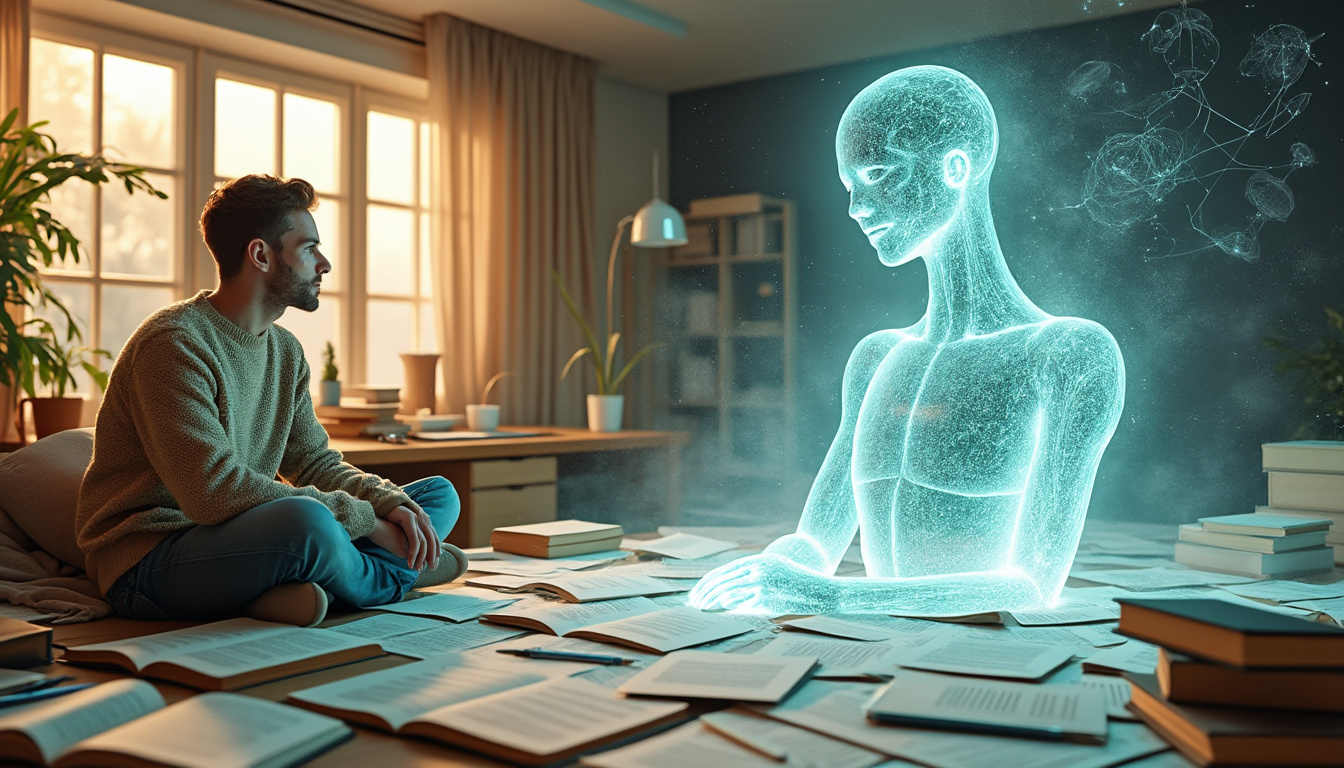
What if ChatGPT already outperforms our own writing?
The question of human creativity in the face of the rise of artificial intelligence (AI) continues to be debated. Recently, during a literary competition organized by Le Nouvel Obs, Hervé Le Tellier, winner of the 2020 Prix Goncourt, was presented with a text generated by AI. This story, although written by an algorithm, raised questions about our future as writers. Are we threatened by automated writing that could surpass our own? As tools like Scribens, Grammarly, Antidote, and ProWritingAid integrate into our creative process, let’s rethink what this means for the literature of tomorrow.
Risk of Creative Flood: AI in Literature
In 2025, the question of competition between human creations and those generated by AI is acute. Faced with machines capable of producing stories, poems, and even works of art, many writers are questioning their place in the field. AI has already proven its ability to produce quality texts, from detective stories to romance novels, enabling a democratization of creativity and radically transforming our approach to writing.
The challenge is set: the application of AI in narrative processes raises the following question: Are we witnessing an industrialization of the imagination? Analyzing the creative process over the centuries, we observe a significant evolution.
- 19th century: Emergence of machines for the automation of physical labor.
- 20th century: Orchestration of computation by complex systems.
- 21st century: Machines imitate our creativity, a process previously considered exclusive to humans.
Concerns, such as those expressed by the “Kasparov of literature” phenomenon, remind us that writers may have to fight to defend their creative space against these automatic generators. But is it possible that this new competition will lead to a renewal in the way we write?
The impact of AI on literary creation
As illustrated by a study published in the journal Nature, some poems written by AIs were preferred to those of great masters like Shakespeare. However, once the public knows they are dealing with a work generated by an algorithm, their opinion changes. This raises a major question: Does literary quality depend solely on the author or on the intention behind the writing?
This paradox highlights the indissoluble link between human intention and artistic appreciation. Indeed, copyright only recognizes human production, ignoring anything AI might generate. AuthorPreferences (before revelation) Preferences (after revelation) Shakespeare 65%
| 35% | AI | 35% |
|---|---|---|
| 65% | This dynamic reveals a tension between the authenticity of creation and the ability of machines to produce works. This phenomenon invites a deeper reflection: | Is AI a tool that redefines our creativity or a threat to our status as artists? |
| Reinventing the Creative Process: AI as a Partner | Perhaps the true value of AI lies in its ability to serve as a catalyst for our creativity. Rather than seeing AI as a threat, let’s consider it as a partner in the act of creation. The Jeu de Paume in Paris, for example, organized an exhibition entitled “The World According to AI,” which examines how these tools can renew our creative processes. | Indeed, AI makes it easy to combine diverse influences and create works that result from the fusion of multiple styles. Historically, artists have often blended diverse inspirations, creating unique works. The only difference today is that AI performs this task at breakneck speed. |
When AI Redefines the Artist Consider the parallel with the arrival of photography in the 19th century. Far from killing painting, this innovation liberated artists, encouraging them to explore new horizons of expression. Thus, AI, by training writers to think outside the box, could also open up unprecedented possibilities.
Therefore, this transition to AI in the literary field could well be, if adopted wisely, a springboard towards a
reinvention of literary creation. As Hervé Le Tellier writes, we may be living in a “moment when everything changes” for literature. New Genres: Emergence of Interactive and Multimedia Stories. Exploring Themes:
Diving into previously avoided topics.
Narrative Techniques:
Using algorithms to construct non-linear narratives.
Understanding Error: A Key to Creativity AI systems are not perfect.Errors, often referred to as glitches or hallucinations, are an integral part of their functioning. These imperfections, which can lead to surprising or even meaningless results, require human intervention to correct. Thus, they open up a new space for creative collaboration.
- When writers encounter aberrant suggestions, they regain control of their creative process, allowing them to reflect and rewrite from the initial error. These glitches, far from being obstacles, are opportunities to question and redefine our relationship with writing. Type of Error
- Consequence Impact on the Writer
- Glitch Narrative Incoherence
Reflection on Originality and Logic
Hallucination Absurd SuggestionsEncouragement to Rewrite and Re-Interrogate Interrogating errors thus becomes a creative exercise, allowing authors to test the stability and interpretation of their narratives. This process could even mark the beginning of a new era of *collaborative literature*, where humans and machines co-write.Creating a New Identity: The Transformation of the Artist
The line between artist and AI could become blurred as this technology establishes itself as a partner. This synergy may not be an end, but a beginning, for a
| redefinition of the role of the artist. | The immense potential of AI pushes us to explore what makes us human: our subjectivity, our lived experience, and our vulnerability. | Because, ultimately, creativity is not just about novelty or the recombination of ideas, but emerges from human limitations. AI, while a tool, is also a mirror that reflects us back to ourselves. In the year 2025, it is therefore up to us to choose to adopt these new practices while preserving the essence of our writing. |
|---|---|---|
| Integration of trends: | Follow technological developments without compromising authenticity. | Evolution of storytelling: |
| Use interactive narratives that engage the reader. | Use of various tools: | Integrate software like Ginger Software and Hemingway Editor to improve clarity. |
Catégories : News & AI
Tags : artificial intelligence, chatgpt, creativity, technology, writing